Turning HOP Principles into Action: Error is Normal
I will be writing a 5-part blog series on the 5 Principles of Human and Organizational Performance (HOP) because I have heard dissatisfaction from many leaders attempting to implement HOP inside their organizations. I want to start by saying I am a big fan of a systems approach to managing safety and have been pushing leaders to understand how organizational systems and processes influence behavior throughout my career. It is something I adopted from my behavioral education with pivotal influence coming from pioneers such as Deming, Gilbert, Rummler and Brache, and Mager and Pipe. The frustration I hear from leaders when implementing HOP does not have to do with the 5 principles themselves, but rather what it actually looks like to implement them. Specifically, what behaviors should leaders be doing on a daily/ weekly basis to implement each of the principles, and what should they do when an incident occurs. This is an error with pinpointing and positive reinforcement. This blog series will provide specific actions leaders can take to implement HOP. While this will not be an exhaustive list, my hope is that it will give you a starting point.
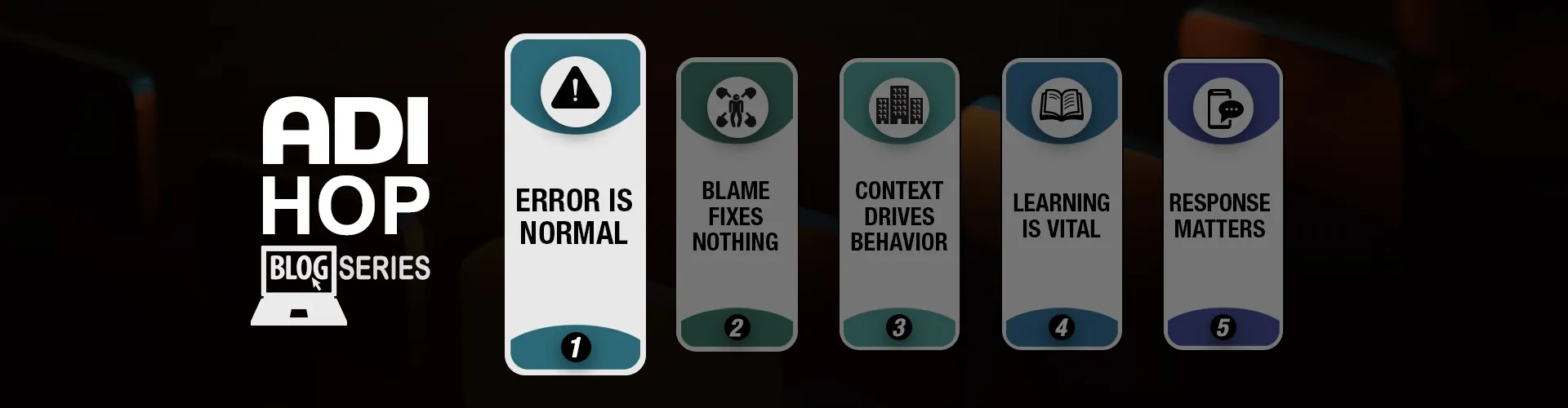
HOP Principle 1: Error is normal
Human error is inevitable and a normal part of human behavior. Rather than trying to eliminate errors, organizations should focus on building systems that are resilient and can safely manage mistakes.
Consider these concepts when pinpointing what leaders can do to put actions behind this principle.
- Humans are not machines; we do not produce identical and unchanged behavior patterns. We are never perfect. Our behavior is highly influenced by environmental factors. As work environments shift daily/weekly, so does the approach to working. No one ever took a job promising to deliver perfection.
- Organizations are filled with failure points: undue production pressures, lack of resources, poor training, poorly designed processes or procedures, lack of trained and qualified people, and competing messages/priorities. You can’t “good job” someone’s behavior through a bad system.
- Our behavior is highly influenced by consequences. We repeat behaviors that work for us and discard behaviors that don’t. Positive consequences such as saving time and saving effort are often produced when someone engages in at-risk behavior (e.g., taking a short cut). These are often prevalent in poorly designed systems, processes, and procedures.
What are critical behaviors leaders should do to help their organizations deal with the first principle of HOP? The following are proactive behaviors or actions leaders should build into their daily / weekly habits to ensure their organization is living out this HOP principle.
Proactive Behaviors for HOP Principle 1
Become relentless in improving processes and procedures. The intersection of systems and behavior often lead to encouraging deviations in performance due to poor design. Even when a project is completed successfully, that does not mean systems or procedures produced deviation free work. It could mean people got lucky. Leaders should build a system of regular refinement of processes and procedures to have multiple safeguards in place. To help identify potential areas for improvement, leaders can build question-asking techniques into their regular leadership practices. Ask questions such as:
- What is the most annoying or frustrating thing you’ve had to do today to work safely?
- What’s one improvement you’d like to see in this process to reduce risk?
- What can be done to improve the procedure you have just finished to make it easier to work safely?
- What can we do to make this procedure easier or faster for you?
- Are there any changes we’ve made that have generated more harm than good?
Once leaders incorporate questions about the work as designed, improvements to them can be made. More about this in a future blog.
Incorporate safety professionals and the workforce into work planning. In many organizations, work planning is significantly disconnected from the work itself. To ensure people can fail safely, safety professionals and worker representation should become part of the planning process. If resources cannot support this recommendation fully, organizations should create criteria in which these additional resources are brought into the planning process, such as risk or SIF potential, the routine level of the job, or based on job location. The additional resources will allow for better planning of the work and increase safety in its design.
Identify and remove failure points. Failure points increase risk and SIF potential inside organizations. Leaders should build into their regular leadership practices looking for and eliminating such failure points. They exist in areas like training, resources, tools, time, human power, procedures, etc. Identifying failure points can be done by asking the frontline questions such as:
- What do we need to do to make work easier or faster for you?
- What are problem areas you see that make working safety hard?
- Do you think people are given the training, tools, or resources to work as safely as possible? What can leaders do to improve any of these things?
- What are the problem areas you see inside the organization that are increasing risk potential?
Observe and positively reinforce safe work. While errors may be normal, so is our ability to build safe habits. Strengthening behavior beyond compliance requires positive reinforcement. Leaders should become excellent at providing positive feedback and build time into their daily/weekly routine to observe work. For supervisors, this should be daily with the jobs selected based on SIF potential. For managers, consider following along with supervisors several times a week to provide coaching to the supervisor and be an additional source of reinforcement for key behaviors related to hazard recognition and risk mitigation, as well as behaviors that purposefully reduce SIF potential.
Principles are only helpful when people know what to do to apply them. The first principle of HOP is about ensuring leaders are doing everything they can to design systems, processes, and work that allow for some deviation of work without increasing the potential for injury. Ensuring positive reinforcement exists for critical safe behaviors is also key to helping people build safe work practices and expertise in working safely when risk is present. Building leadership habits around these principles is needed to build a safer organization.
References
Gilbert, T.F. (2007). Human competence: Engineering worthy performance. San Francisco: Pfeiffer.
Mager, R. F., & Pipe, P. (1997). Analyzing performance problems, or, You really oughta wanna (3rd ed.). Center for Effective Performance.
Rummler, G.A. and Brache, A.P. (1995). Improving performance: How to manage the white space on the organization chart. Jossey-Bass Publishers.